
Jim Lassoie: Forty Years of Friendship, From The Antlers to Mt. Hood
I arrived at Cornell in the fall of 1979, twenty-five years old and carrying the particular hunger of someone who had found his calling late enough to appreciate it. My initial advisor was Larry Hamilton, a forest ecologist whose leadership in UNESCO's Man and the Biosphere Programme—specifically Project 6, focused on mountain ecosystems—had drawn me to Ithaca. Within a year, Larry announced his retirement to the East-West Center in Honolulu—a well-deserved transition for him, but one that left me suddenly unmoored in the early stages of a doctoral program.
What happened next took approximately one beer.
Jim Lassoie was a young assistant professor then, maybe five years into his Cornell career, building a reputation in tree physiology and forest ecology. I knew him casually from department seminars and the informal gatherings that define graduate student life. Someone—I no longer remember who—suggested I talk to Jim about taking over my committee. We met at The Antlers, a bar past Varna on Dryden Road that served as an unofficial annex to Fernow Hall, and over a beer I explained my situation. Jim's response was characteristically direct: "Sure, the more the merrier."
That phrase captures something essential about Jim Lassoie. Where other faculty might have hedged, asked to see my prospectus, or worried about the complications of inheriting another professor's student, Jim simply made room. It was the first of many acts of generous inclusion that would define our relationship over the next forty-five years.
The Antlers became our advising office. Jim, Charlie Smith, and I would commandeer a booth and work through the intellectual problems of my dissertation over pitchers of beer and whatever was on special. This was not unusual for the era—academic culture was different then, more porous between formal and informal spaces—but Jim made it work pedagogically. The relaxed setting lowered defenses, encouraged speculation, allowed ideas to be tried and discarded without the weight of seminar-room judgment. Some of my best thinking happened in that booth.
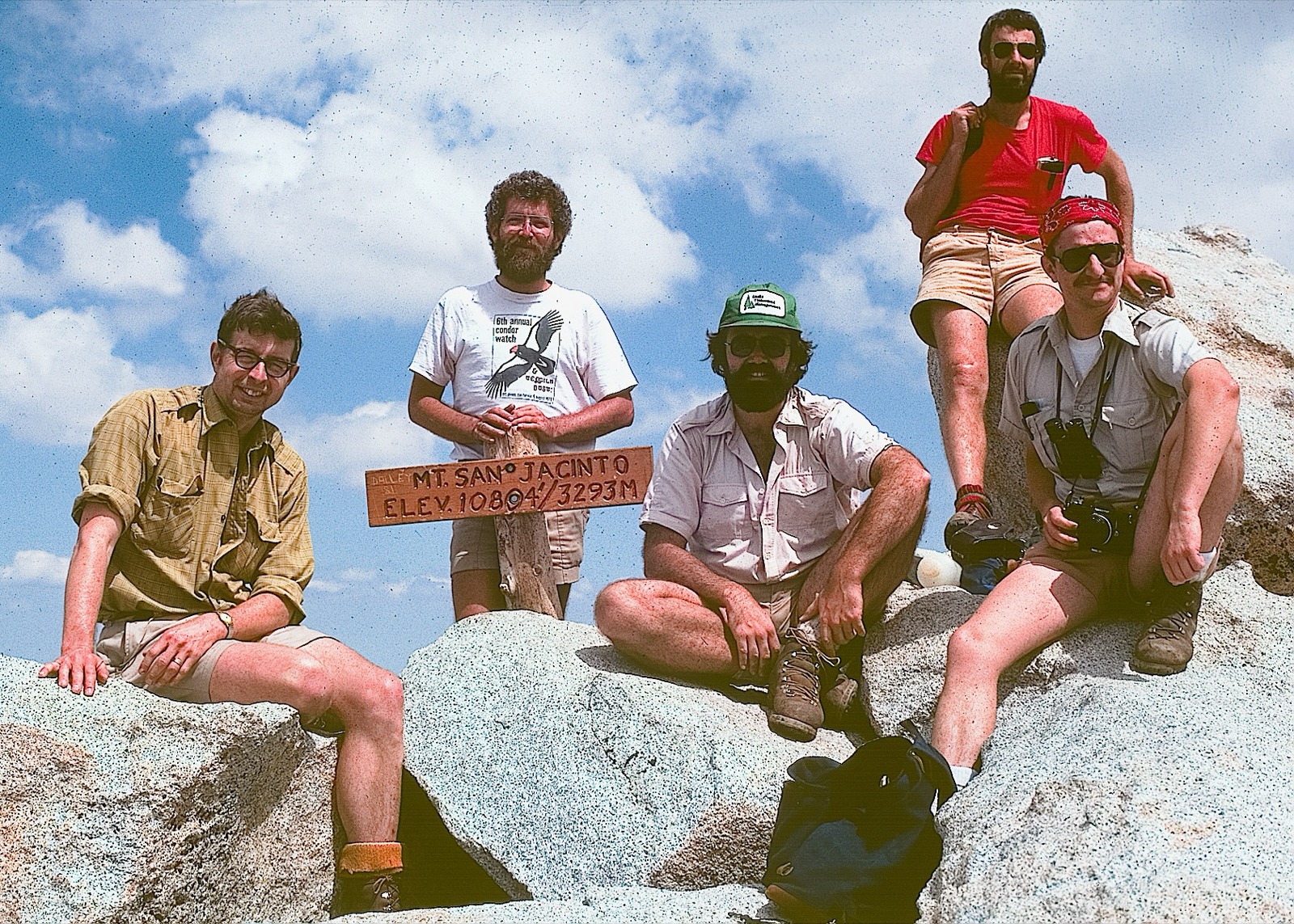
In the summer of 1981, my entire doctoral committee—Jim Lassoie, Ted Hullar, Peter Marks, and Charlie Smith—flew to California to hike with me to the summit of San Jacinto Peak. I have a photograph from that trip: five men in hiking boots and short shorts, seated on granite boulders at 10,834 feet, the sign marking "Mt. San Jacinto" visible behind us. Ted is in a green shirt, looking every bit the wilderness philosopher he was. Jim wears a green ball cap and dark aviator glasses. Peter Marks is in red. Charlie Smith has binoculars around his neck—he was director of Education at the Cornell Lab of Ornithology. I'm the one standing behind the sign with the enormous glasses and the relieved expression of someone whose committee has just experienced firsthand the landscape he's been trying to describe in his dissertation.
That trip was Jim's idea. He understood that my work on the San Jacinto Mountains couldn't be fully grasped from Ithaca, that the committee needed to feel the elevation gradient from Sonoran desert to alpine meadow, to see the five life zones compressed into nine miles of vertical relief. It was an extravagance of time and money that would be hard to arrange today, and it made all the difference. When I defended my dissertation in 1983, my committee knew exactly what I was talking about.
The winter of 1980 brought catastrophe. I was living in a small trailer on a forty-acre woodlot overlooking Cayuga Lake—cheap housing for a graduate student, beautiful in its isolation, heated by a woodstove. Over Christmas break, while I was visiting family in California, the trailer caught fire and burned to the ground. The fire department wasn't sure at first whether I'd been inside. The department organized what they called a "house burning" party—a fundraiser to help me replace what I'd lost—and the community's response revealed something about the culture Jim and others had built. Graduate students and faculty showed up, wrote checks, offered spare rooms. I rebuilt, in every sense.
Ann and I were married in 1982, both of us graduate students, both of us finding our footing. Jim helped organize my bachelor party, which someone themed around the film "Quest for Fire"—a decision whose full implications I've chosen not to document. What I can say is that by May 1983, when I walked across the stage in Barton Hall to receive my doctorate, Jim Lassoie had become something more than an advisor. He was a colleague, a co-conspirator, a friend.
I was one of Jim's first three doctoral students. Marty Welbourne and I graduated together in that 1983 cohort, the inaugural class of Lassoie PhDs. There's something binding about being first—you're the experiment, the proof of concept, the evidence that a young professor can shepherd students through the maze. Jim was learning how to advise even as we were learning how to be advised, and the mutual improvisation created a particular intimacy.
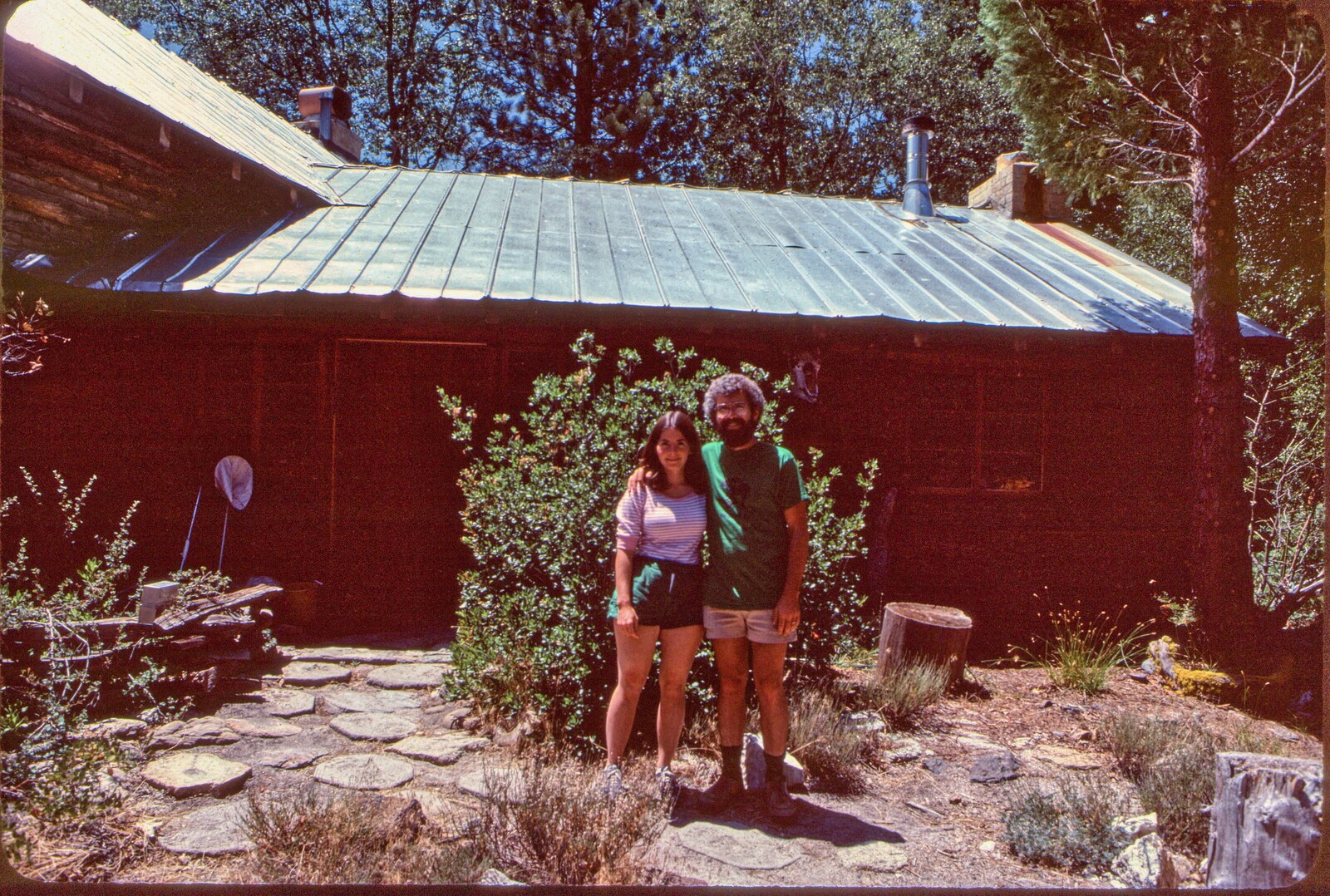
By August 1982, Ann and I had moved to the James San Jacinto Mountains Reserve, where I would serve as Resident Director for the next twenty-six years. I finished writing my dissertation in a cabin at 5,500 feet, surrounded by the very forest I was describing. And it was there, in that cabin, that Jim and I began the collaboration that would give my life's work its name.
The Macroscope started as a pedagogical problem. How do you teach ecology to students who can't spend months in the field? How do you convey the complexity of an ecosystem—the spatial relationships, the seasonal rhythms, the taxonomic diversity—through a classroom experience? Jim was teaching forestry and environmental education at Cornell; I was sitting on thousands of images of San Jacinto's flora, fauna, and landscapes, hundreds of aerial photographs, reams of TWINSPAN and DCA printouts showing species gradients across elevation for every woody plant and tree, and field notebooks describing the botanical biodiversity of two wilderness areas. Together, we imagined something that didn't yet exist: an interactive multimedia system that would let students explore an ecosystem as naturalist, ecologist, or spatial navigator.
We called it the Macroscope, borrowing the term from Joël de Rosnay's 1979 book about systems thinking. The name felt right—a tool for seeing patterns at scales too large for direct observation, the complement to the microscope's revelations of the very small. We presented our system at the Forestry Microcomputer Software Symposium in Morgantown, West Virginia, in the summer of 1986: fifteen pages describing an Apple IIe connected to a Pioneer laserdisc player, fifty-four thousand images accessible in three seconds, touch-screen navigation through five ecosystem types and three community strata.
Reading that paper now, forty years later, I'm struck by how clearly we articulated principles I'm still working with. We described three "epistemological entry points": the Explorer (spatial and perspectival), the Naturalist (taxonomic and community-based), and the Ecologist (process and gradient-oriented). We discussed how different users—a child, a biology major, a professional ecologist—would navigate the same database in fundamentally different ways. We worried about cognitive overload and the importance of multiple pathways to the same destination.
What I didn't know then was that Jim and I were diverging even as we collaborated. The Macroscope paper represents a moment of intersection between two trajectories that were already beginning to separate.
Jim's path took him away from tree physiology and toward international conservation. I've read the interviews where he describes this pivot: "I always thought I was going to be a scientist but I didn't love it—it wasn't a passion. I had concerns that a lot of our research and especially the stuff I was doing in ecology and tree physiology were very detached from the needs of people." By the late 1980s, Jim was becoming something different—not a bench scientist extrapolating from Douglas-fir water relations, but an educator and facilitator working with communities from China to Costa Rica.
He served as department chair from 1988 to 93, then was appointed International Professor—a title that captured his transformation. From 1996 - 2002 Jim served as the Director of the Cornell Center for the Environment. Over the next two decades, he advised more than a hundred graduate students doing research across four continents. He spent twenty years teaching and collaborating in China, became an adjunct professor at Beijing Normal University, developed the Conservation Bridge website to bring real-world conservation challenges into classrooms through video and practitioner dialogue. When he retired at the end of 2020, he had published over 180 research articles and won every teaching award Cornell offers, including the Louis and Edith Edgerton Career Teaching Award and the Kendall S. Carpenter Memorial Advising Award.
My own path led deeper into technology. The Macroscope laserdisc gave way to networked sensors, wireless mesh networks, robotic cameras, autonomous sampling systems. I co-founded the Center for Embedded Networked Sensing with forty million dollars of NSF funding, built the Robot Forest at the James Reserve, deployed the Very Large Ecological Array at Blue Oak Ranch. The epistemological framework Jim and I developed in 1986—Explorer, Naturalist, Ecologist—evolved into EARTH, LIFE, HOME, and SELF, the four domains of what I still call the Macroscope paradigm.
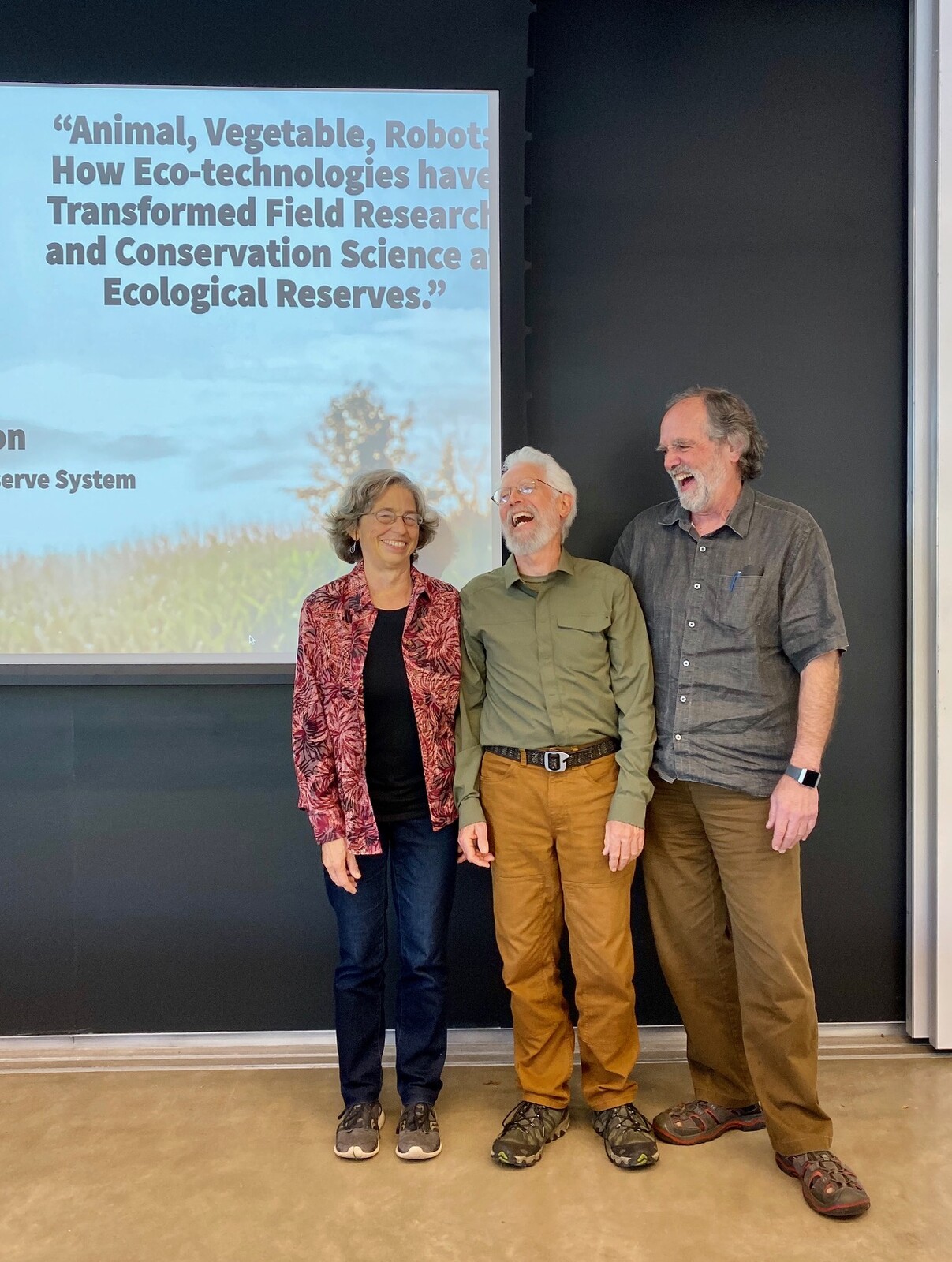
In October 2019, a year before Jim's retirement, the Department of Natural Resources invited his former students back to Cornell to speak about their careers. I put together a presentation called "Animal Vegetable Robot: How Eco-Technologies have Transformed Field Research and Conservation Science at UC Natural Reserves." Fifty-four slides tracing the arc from that 1981 committee hike to hovering drones sampling lake chemistry. I included the Macroscope laserdisc system, credited Jim by name, and ended with Richard Brautigan's poem about a cybernetic meadow where mammals and computers live together in mutually programming harmony.
Standing in that lecture hall, looking out at the audience that included Jim himself, I felt the full weight of forty years. The bearded young man holding laserdisc platters in 1984 had become a gray-haired emeritus. The young professor who said "sure, the more the merrier" had advised a hundred students and changed the field. We had both pivoted—Jim toward people and communities, me toward sensors and systems—and yet the underlying commitment remained the same. We wanted to make distant places and complex systems accessible. We wanted to democratize the naturalist's knowledge. We wanted, in Brautigan's phrase, to be watched over by machines of loving grace.
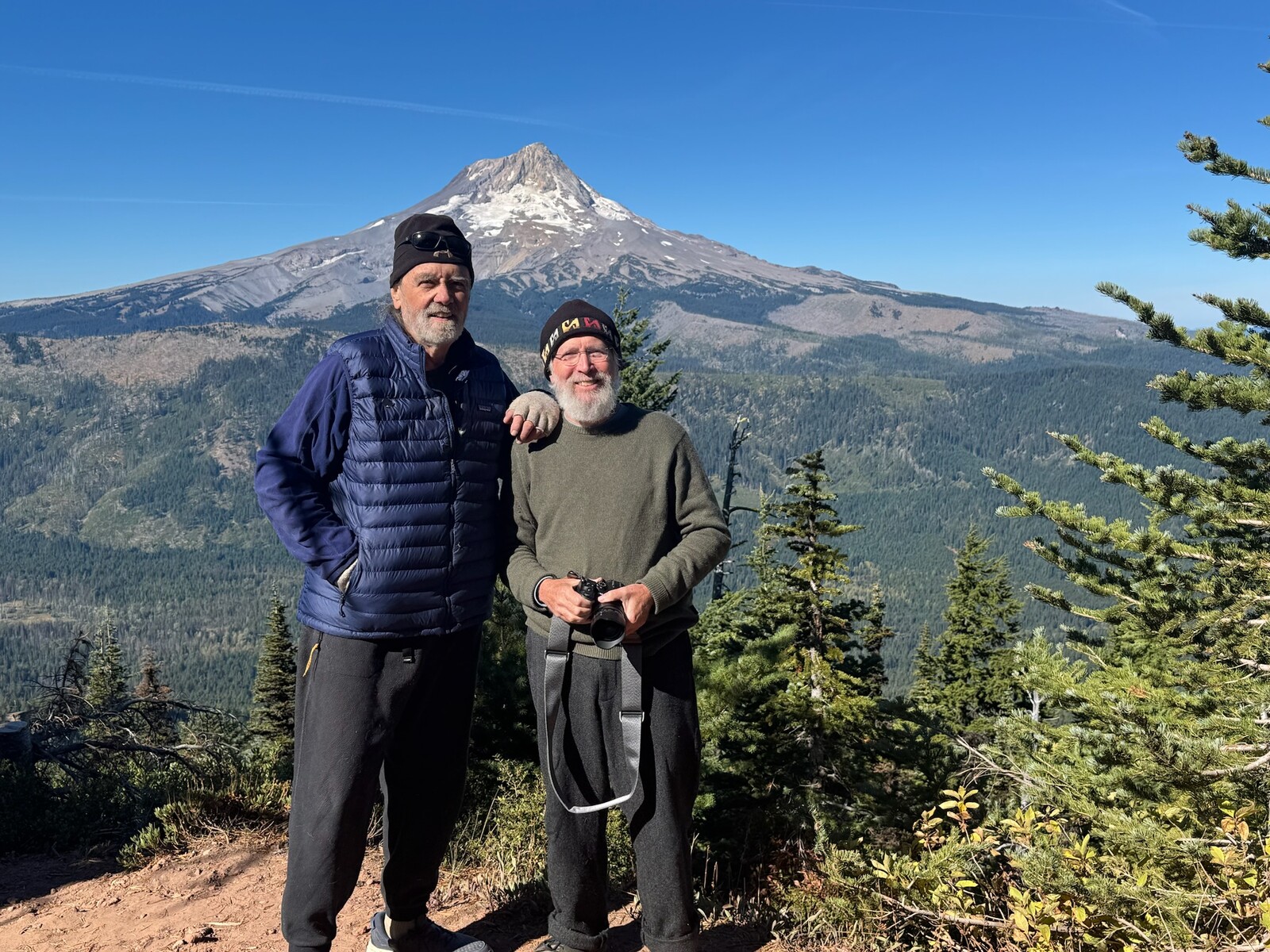
Last October, Jim and I met again at Mt. Hood. He and his wife Ruth were in the midst of an epic journey—the Pacific Crest Overlanding Trail, from the Canadian border to the Mexican border via gravel tracks and roads that sometimes required four-wheel drive. I joined them at Hood River and said my goodbyes at Breitenbush Hot Springs near Detroit, Oregon. There's a photograph from that reunion, forty-three years after San Jacinto: Jim and I with Mt Hood towering behind us, a seventy-nine-year-old retired professor still chasing wild places.
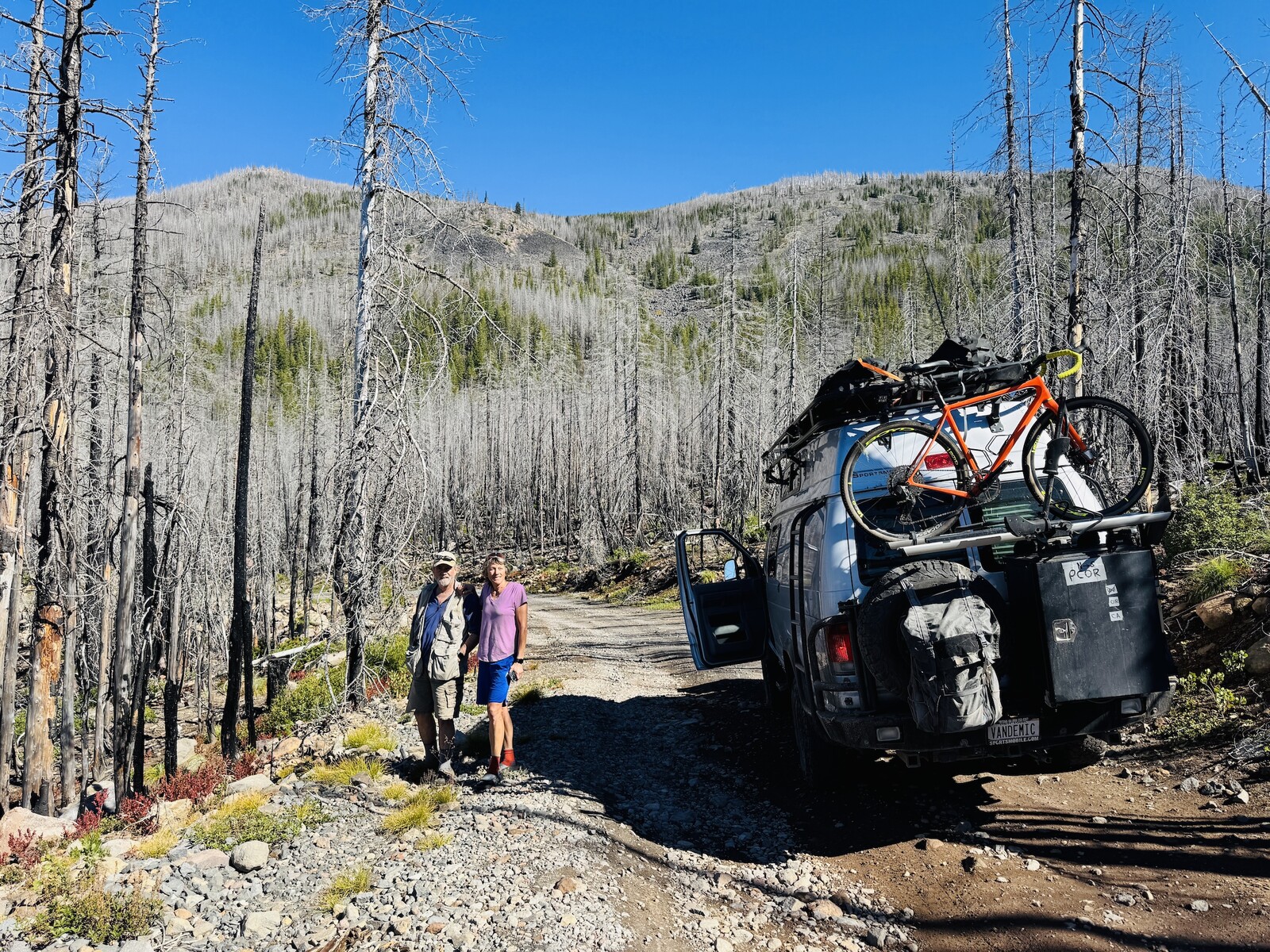
What do you say to someone who changed your life over a beer and never made a fuss about it? Jim's gift was making space—for students, for ideas, for the kind of meandering intellectual development that can't be scheduled or assessed. He took me on when I was orphaned, let me finish my degree in a cabin three thousand miles away, collaborated on a project that gave me my life's work's name, and then watched with evident pleasure as I took that work in directions neither of us could have predicted.
I've been writing these mentorship essays as a way of reckoning with debts that can't be repaid. Ted Hullar taught me to think about wilderness as philosophy. Jim Lassoie taught me that generosity is a form of intelligence—that saying "sure, the more the merrier" can be the most important pedagogical act a teacher ever performs.
The laserdisc technology is museum-piece now. But the Macroscope endures, evolved beyond recognition into sensor networks and AI agents and real-time data streams from distributed instruments. And somewhere in all of it—in every dashboard I build, every STRATA conversation, every morning coffee session where I try to make sense of what the instruments are telling me—there's an echo of a young professor saying yes to a student who needed a home.
Thanks, Jim. For everything.
References
- - Cornell University Department of Natural Resources (2019). Faculty profile: James P. Lassoie, International Professor. ↗
- - Hamilton, M.P. & Lassoie, J.P. (1986). "The Macroscope: An Interactive Videodisc System for Environmental and Forestry Education." Forestry Microcomputer Software Symposium, Morgantown, WV, June 30-July 2, 1986. ↗
- - Hamilton, M.P. (2019). "Animal Vegetable Robot: How Eco-Technologies have Transformed Field Research and Conservation Science at UC Natural Reserves." Presentation to Department of Natural Resources, Cornell University, October 2019. ↗