
The Wolf in the Living Room: Genetic Entanglement and the Family Dog
The paper arrived in my morning reading queue on November 24th, published in PNAS by Audrey Lin and Logan Kistler at the Smithsonian. Its title—"A legacy of genetic entanglement with wolves shapes modern dogs"—seemed distant from my immediate concerns. I was drinking coffee in Oregon City, watching the pre-dawn darkness through windows that face the Willamette River canyon. Four blocks away, my daughter's household was likely to be stirring, including an eight-year-old chihuahua named Chewbacca who has, over the years, become something between a granddog and a colleague.
I did not expect to spend the next hour thinking about him while reading about 2,693 ancient and modern canid genomes.
The conventional wisdom has long held that dogs and wolves, despite their ability to interbreed and produce fertile offspring, represent a clean evolutionary break. Dogs domesticated roughly 23,000 years ago, the story goes, and thereafter maintained reproductive isolation from their wild progenitors. Genome-wide statistical tests supported this narrative. When researchers examined ancient dog genomes spanning 11,000 years across the Northern Hemisphere using f4 statistics, wolf ancestry simply didn't appear. Dogs were dogs. Wolves were wolves. The boundary seemed clear.
Lin and Kistler's contribution is methodological before it is biological. They applied local ancestry inference—a technique developed for human genomics—to detect introgressed haploblocks at a resolution previous methods couldn't achieve. The results upend the clean separation story. Almost two-thirds of modern breed dogs carry wolf ancestry from admixture that occurred nearly a thousand generations ago. Among free-living village dogs, the figure is 100 percent. Every village dog genome they analyzed contains ancient wolf sequences.
The amounts are small—approximately 0.14% of individual nuclear genomes on average, with breed dogs carrying a mean of 6.44 million base pairs of wolf-derived DNA. But the ubiquity is striking. Wolf ancestry blocks cover 96.64% of the autosomal reference genome when you aggregate across all analyzed dogs. The wolf contribution is diffuse but everywhere, scattered in fragments averaging 145.9 kilobase pairs, the shortness of which indicates ancient admixture events progressively chopped by recombination over hundreds of generations.
Here is where the paper became personal: chihuahuas carry approximately 0.2% wolf ancestry.
That figure translates to roughly 4.4 million base pairs of genetic material inherited from wolves that interbred with the ancestors of modern chihuahuas sometime in the deep past, probably around 873 generations ago if the authors' timing estimates hold. The wolf sequences persist, distributed across the genome in fragments too short to detect with older statistical methods but unmistakable under local ancestry inference.
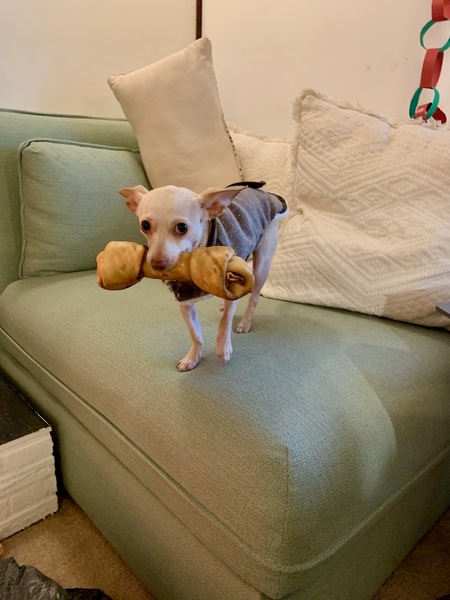
Chewy weighs perhaps eight pounds. He wears a sweater when it's cold. And somewhere in his genome, scattered across his chromosomes in fragments averaging a hundred thousand base pairs, lies genetic material from Pleistocene wolves.
The paper's authors are careful to distinguish between genome-wide patterns and individual traits. They cannot establish whether wolf genes are responsible for specific phenotypes, whether genomic wolf ancestry is simply tolerated when certain characteristics are sought by breeders, or whether correlations derive from ancestry overlapping breeding priorities rather than functional links. But they do find patterns in the aggregate data.
Low wolf-content dogs are more frequently described in breed standards as "friendly," "eager to please," "easy to train," "courageous," "lively," and "affectionate." High wolf-content dogs trend toward "suspicious of strangers," "independent," "dignified," "alert," "loyal," "reserved," and "territorial." The descriptor most differentially associated with high wolf ancestry is "suspicious of strangers." The descriptor most associated with low wolf ancestry is "friendly."
Chihuahuas, sitting at the lower end of the wolf ancestry distribution, should theoretically cluster with the friendly-eager-affectionate group. Breed standards certainly describe them that way. The population-level statistics predict a certain behavioral profile.
Chewy did not read the statistics.

He is watchful to the point of vigilance. Strangers receive sustained assessment, not welcoming enthusiasm. His relationship with my granddaughter—who is eleven and has known him since she was three—operates not on the transactional logic of treat-dispensing humans but on the social logic of packmates. He positions himself relative to her. He asserts precedence. He corrects her when she violates his sense of proper protocol. He treats her, in short, as a sibling rather than an authority figure or a playmate.
The paper discusses the strikingly different social organization between dogs and wolves. Wolves form nuclear family units with monogamous paired adults, juveniles, and puppies, with pack success dependent on cohesion. Free-ranging dogs occupy human environments with much more flexible pack organization, subsisting primarily on human food waste. Village dogs are typically free-ranging without dedicated owners but may rely on humans for feeding.
Chewy's situation inverts the village dog model. He has not one household but two, separated by four blocks in Oregon City. Our families ebb and flow each week between homes. He has internalized this arrangement as a single extended territory with two denning sites. My house is his habitat as much as my daughter's house is. The flexibility the authors describe—the capacity for dogs to adapt to human social structures rather than maintaining rigid wolf-style boundaries—Chewy embodies completely. He simply extended the adaptation to encompass a multi-household human pack.
What interests me most, reading the paper through the lens of lived experience with one particular dog, is the tension between population genetics and individual beings. Lin and Kistler analyze 1,872 dogs and 57 wolves. They find statistically significant correlations between wolf ancestry and size, breed category, and personality descriptors. They identify adaptive introgression at olfactory receptor genes in village dogs, suggesting that wolf alleles may have enhanced sensory acuity for free-living dogs navigating challenging environments without human care. They document the EPAS1 variant that confers high-altitude hypoxia tolerance in Tibetan Mastiffs, a clear case of wolf genes providing adaptive advantage.
But statistics describe distributions. They tell you about tendencies across populations, not about the specific creature currently asleep on my daughter's couch four blocks away.
The phenotype-genotype relationship in dogs is complicated by 23,000 years of coevolution with humans, by artificial selection pressures that varied wildly across time and geography, by the genetic bottlenecks of breed formation in the Victorian era, by the peculiarities of individual development and experience. Chewy's behavioral repertoire—his watchful skepticism, his sibling-style relationship with Madeleine, his easy movement between households—emerges from all of these factors tangled together, not from his 0.2% wolf ancestry alone.
And yet. The paper documents that four of five mitochondrial haplogroups in dogs are more closely related to wolf populations than to other dogs. It shows that zero of 1,582 individual gene trees support dog monophyly—that is, no single gene, examined independently, groups all dogs together to the exclusion of wolves. The genome-wide signal of clean separation dissolves when you examine individual loci. The boundary between dog and wolf exists as a statistical tendency, not an absolute barrier.
In the same way, the boundary between species in my household exists as a social convention, not an ontological fact. Chewy treats Madeleine as pack. Madeleine has grown up bilingual in human and canine social signaling. The paper's phrase "genetic entanglement" captures something true at the molecular level, but there is also behavioral entanglement, social entanglement, emotional entanglement. Twenty-three thousand years of coevolution have woven human and canine lives together in ways that neither species would have developed alone.

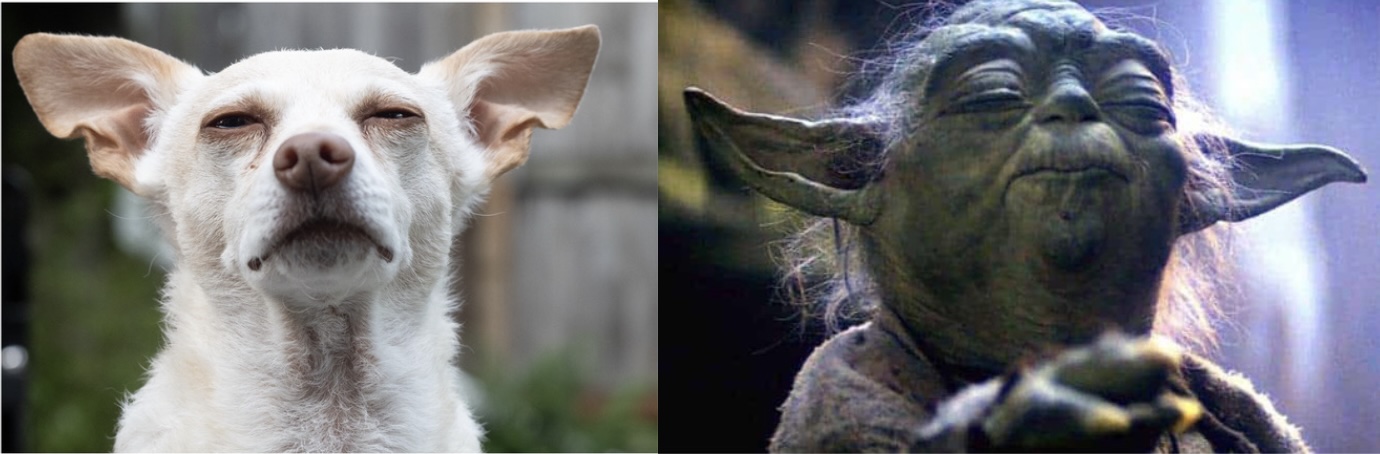
My daughter Caitlin is a professional photographer who has recently been expanding into pet photography. Her images of Chewy—the contemplative gaze over the couch edge, the Yoda-comparison shot with matching meditative expressions and oversized ears—capture something the genomics cannot: the specific presence of this particular animal in this particular family's life. The photographs document an individual, not a population. They record eight years of accumulated relationship, daily observations, shared routines.
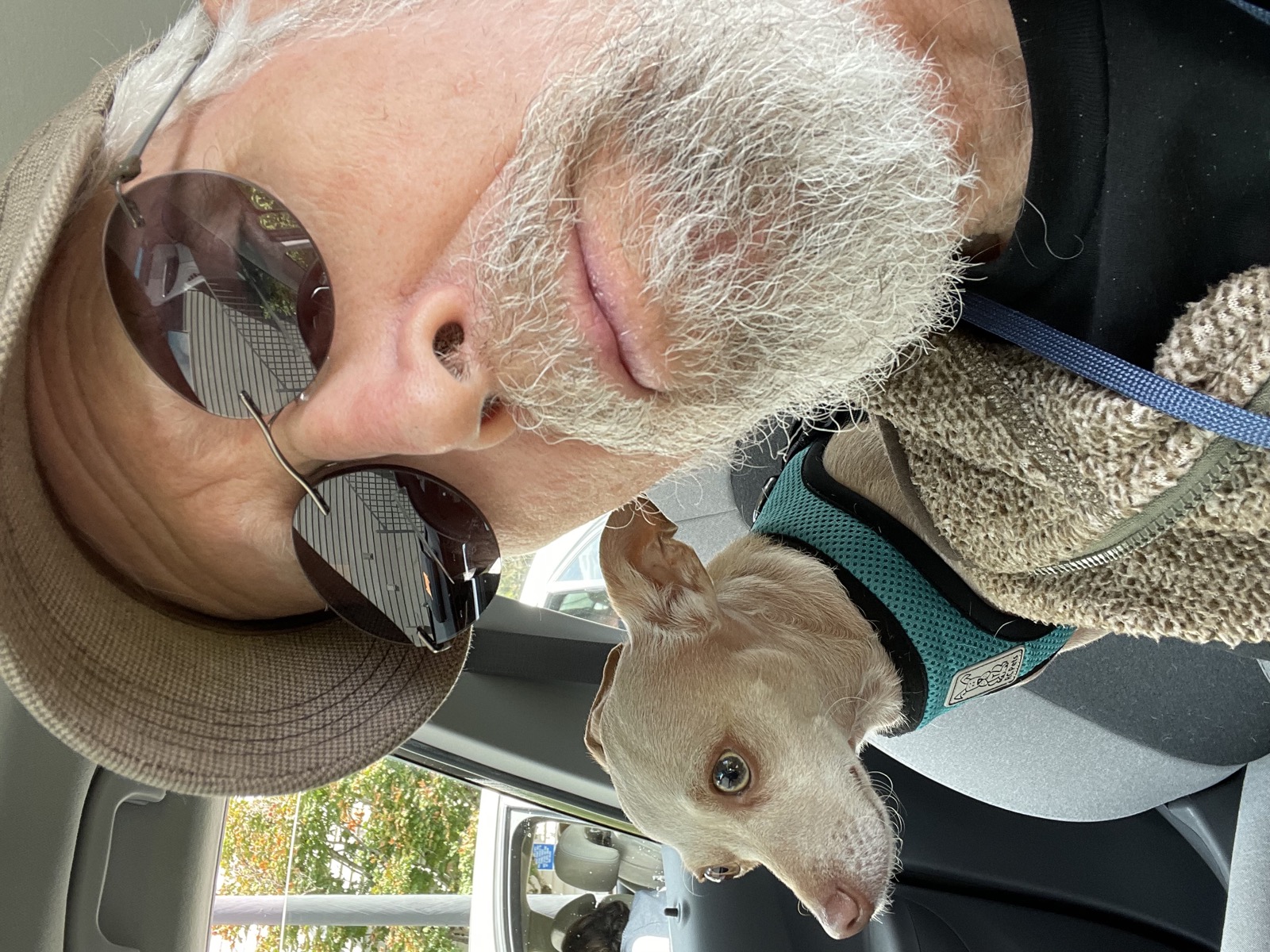
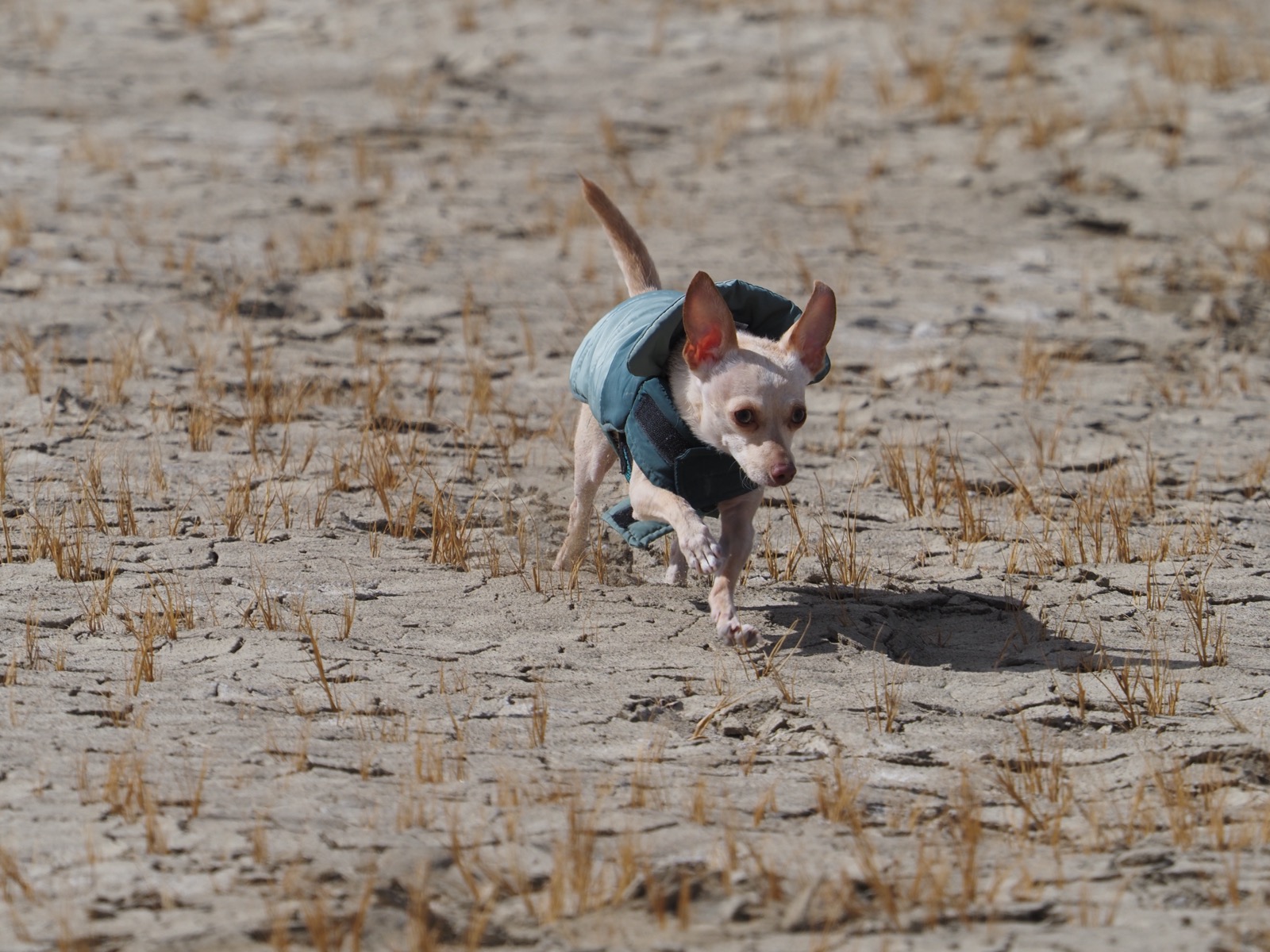
One image shows Chewy in the car with me, riding in his harness, watching the road with characteristic alertness. Another catches him adeptly wielding a rawhide chew nearly as large as himself, the predatory motor pattern compressed into domestic play—orient, eye, stalk, chase, grab—software wolves wrote, running on hardware that weighs less than a house cat. The paper mentions that wolves depend greatly on their sense of smell to navigate surroundings, find prey, mark territories, and recognize one another, while domestication has reduced olfactory capacity in dogs relative to wolves. Looking at Chewy working a scent trail in the backyard, I wonder how much of that capacity his 0.2% wolf ancestry has preserved.
Lin and Kistler conclude that wolf-derived genomic ancestry may have served as valuable source material for adaptability in diverse postdomestication environments. The full scope, scale, and functional implications of the evolutionary interplay between dogs and wolves remain to be explored. They are appropriately cautious about overstating their findings, noting that the current analysis cannot distinguish between human-driven selection for wolf ancestry and simple tolerance of wolf ancestry during historical selection for breed traits.
I am less cautious, in the way that lived experience makes one less cautious than peer-reviewed publication allows. Watching Chewy patrol the perimeter of my living room, take out his territory on his preferred fur-lined chair, assess a visitor with sustained attention before deciding whether to permit approach, settle into my lap with the proprietary air of a creature who knows exactly where he belongs in the pack hierarchy—I see the wolf ancestry the paper documents. Not because I can identify specific behaviors linked to specific alleles, but because the paper has given me a framework for understanding what I was already observing.
The genetic entanglement is real. The fragments of wolf DNA persist in chihuahua genomes just as they persist in Great Danes and Labrador Retrievers and the livestock guardian dogs of the Caucasus. The clean separation story was always too simple. Dogs and wolves have been exchanging genetic material across the entire history of domestication, and the traces of that exchange remain legible to sufficiently sensitive analytical methods.
But the entanglement that matters most is not genetic. It is the social and emotional interweaving of human and canine lives across households and generations. It is my daughter photographing her canine companion with professional skill. It is my granddaughter negotiating sibling dynamics with a creature from another species. It is an eight-year-old chihuahua who has mapped the rhythms of two households four blocks apart and treats both as home.
The paper ends by noting that dog domestication substantially predates the timeframe of introgression observable through current methods, and more ancient gene flow would have been overwritten by later introgression. High-quality ancient genomes will be necessary to enable local ancestry inference deeper into the archaeofaunal record. The full story of dog-wolf genetic exchange remains to be told.
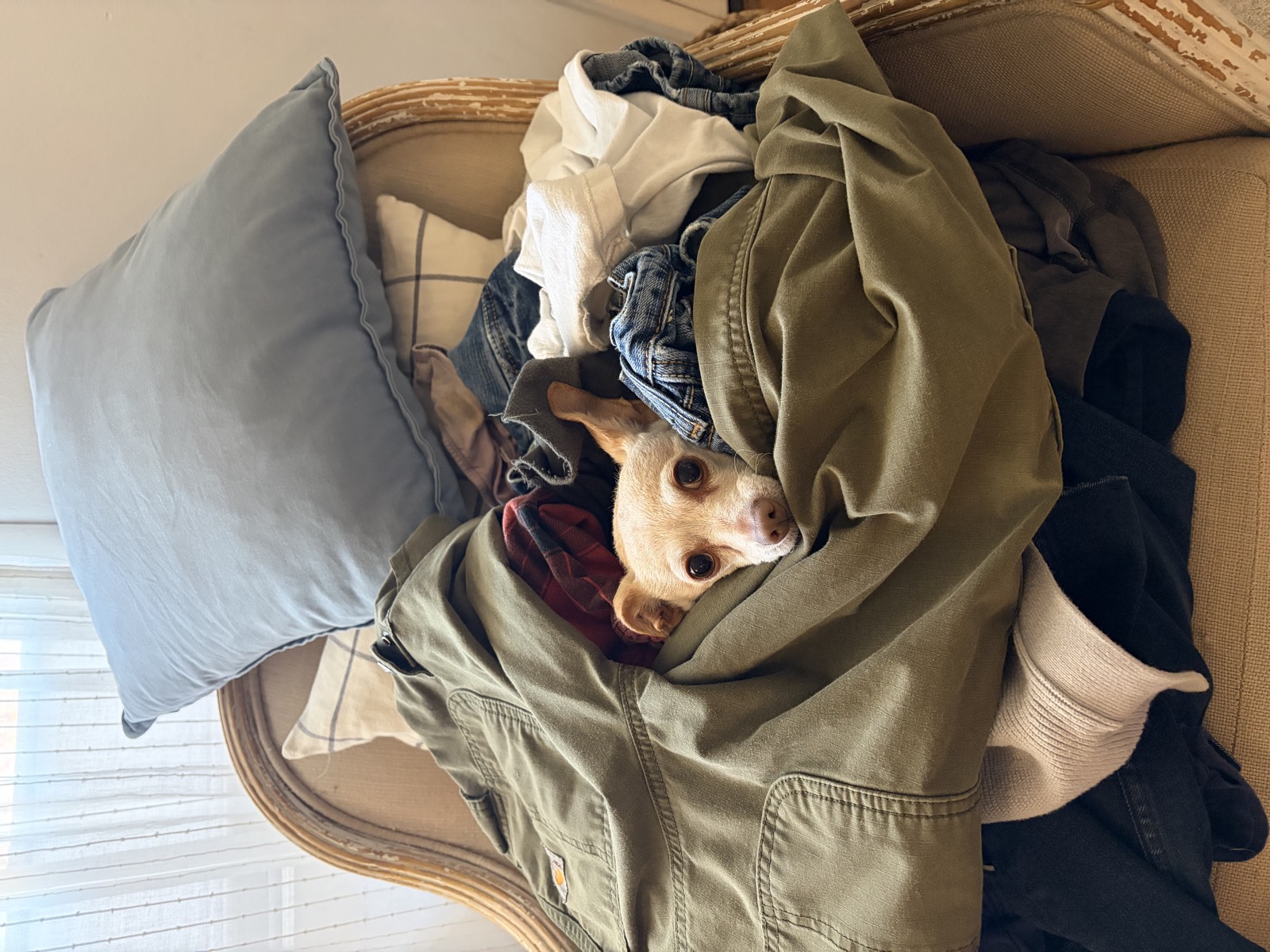
The full story of Chewy's role in our family also remains to be told. Eight years in, he has accumulated enough shared history with us that his behaviors carry meaning beyond what any breed standard could capture. He knows which lap is warmest. He opportunistically chooses a pile of still-warm clothing from the dryer to burrow into for maximum warmth. He knows which sounds indicate visitors worth investigating. He knows, in whatever way dogs know things, that the territory between my house and my daughter's house is all one place, and that the humans who move between them are all one pack.
Somewhere in his cells, fragments of wolf DNA continue to replicate, passed down through a thousand generations from ancestors who hunted the Pleistocene. The paper calls this a legacy of genetic entanglement. I call it Tuesday morning, drinking coffee, reading about genomics while a small alert dog four blocks away prepares to begin his daily patrol of the extended family territory.
The science is remarkable. The lived experience is ordinary. Both are true, and neither diminishes the other.
References
- All photographs © 2025 Caitlin Hamilton. All rights reserved. Images may not be reproduced, distributed, or used without express written permission. caitlinbhamilton.myportfolio.com ↗
- - Lin, A.T., Fairbanks, R.A., Barba-Montoya, J., Liu, H.-L., & Kistler, L. (2025). "A legacy of genetic entanglement with wolves shapes modern dogs." *Proceedings of the National Academy of Sciences*, 122(48), e2421768122. https://doi.org/10.1073/pnas.2421768122 ↗